
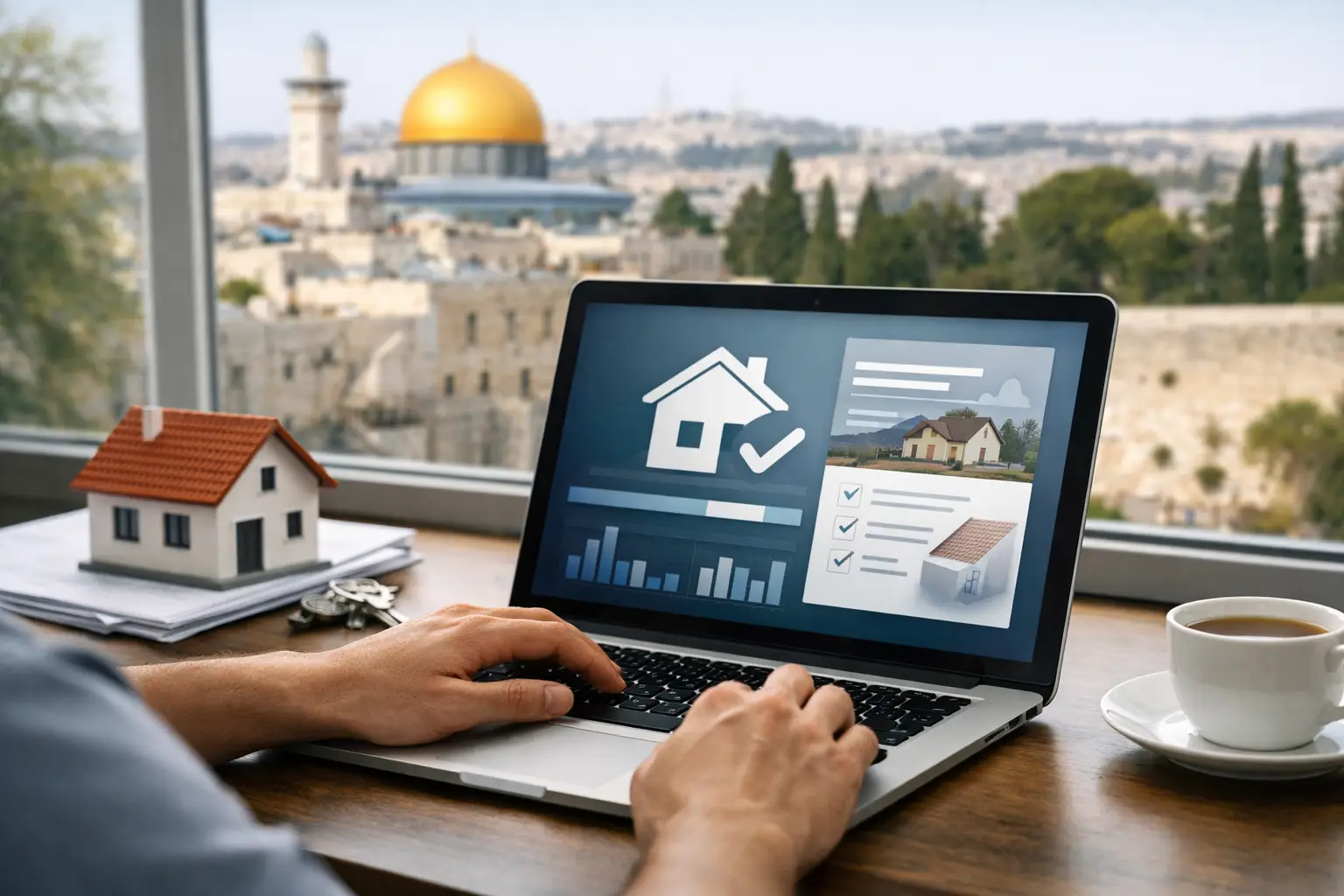
If you are buying property in Israel from abroad, silence is rarely reassuring. A few days without hearing from a bank, broker, or banker can quickly turn into a week of guessing: Did they receive the payslips? Is the foreign income acceptable? Are you waiting on underwriting, or did the file simply stall? That is why mortgage status updates online matter so much for overseas buyers.
For a local buyer sitting across from a bank branch, uncertainty is frustrating. For an overseas buyer managing time zones, foreign income documents, translators, accountants, and a property negotiation, it can derail the whole process. When you cannot see where your mortgage file stands, you are forced to make major decisions with partial information.
Why mortgage status updates online matter more in Israeli mortgages
Israeli mortgage processes can feel opaque even when everything is moving normally. Different banks may ask for different versions of the same document. A file that looks complete to a buyer may still be missing one item the bank considers essential. Foreign-income applicants often face extra review because salary structures, tax documents, company accounts, or rental income may not fit neatly into standard Israeli bank templates.
That creates a simple problem: buyers do not just need updates. They need useful updates.
A message saying "in progress" does not help much if you are deciding whether to sign, negotiate, or wait. A meaningful online status update should tell you what stage the file is in, what is still missing, who is reviewing it, and what the next likely step will be. That kind of visibility reduces stress, but more importantly, it helps you act earlier.
For example, if a bank is waiting on six months of business bank statements rather than three, that is not a minor detail. If you find out early, you can collect them before the file sits idle. If you find out late, your purchase timeline can start slipping.
What buyers actually want from mortgage status updates online
Most buyers are not looking for a fancy dashboard just because it looks modern. They want clarity. They want to know whether they are moving forward, what is blocking progress, and what needs their attention now.
In practice, the most useful mortgage status updates online tend to answer five questions: has the document been received, has it been reviewed, is anything missing, has the file been submitted to a bank, and what happens next. Those are the questions that affect real decisions.
This is especially true when buying in Israel from the US, UK, Canada, or another overseas market. The mortgage process often runs alongside property tours, legal reviews, currency planning, and contract pressure. If the mortgage side is vague, every other part of the purchase becomes harder to manage.
A good update system should also separate activity from progress. Ten emails flying back and forth may feel busy, but they do not necessarily mean the file is advancing. Buyers need to know the difference between admin movement and genuine underwriting movement.
The stages that should be visible online
Not every lender presents mortgage progress in the same way, but buyers benefit when the journey is broken into clear stages.
Document collection and file readiness
This is where many delays begin. Overseas buyers often have income documents from multiple countries, employers, or entities. Some items are straightforward, like ID and bank statements. Others are more nuanced, like foreign tax returns, accountant letters, bonus income, or company ownership documents.
An online status page should make it obvious whether a document is uploaded, under review, approved for use, or still needs correction. "Received" is not the same as "accepted." That distinction matters.
Bank matching and submission
Not every Israeli bank views every borrower profile the same way. A salaried employee paid in dollars may be treated differently from a self-employed applicant with mixed foreign income. A buyer with strong assets but less standard documentation may fit better with one bank than another.
At this stage, updates should show whether the file is still being prepared, whether a bank strategy has been chosen, and when submission has actually happened. Buyers often assume that once documents are uploaded, the bank is already reviewing the file. Sometimes that is true. Sometimes the file is still being cleaned up to avoid preventable problems.
Review, questions, and conditional progress
This is the stage where buyers most need transparency. Banks may request clarifications, ask for updated statements, or want an explanation of income structure. That does not always mean something is wrong. It often means the bank is doing normal review.
Still, there is a big difference between "under review" and "bank requested two missing documents." Online updates should reflect that difference clearly, without burying it in email chains.
Approval path and next actions
A buyer needs to know when the file has moved from early review toward approval, and whether any conditions remain open. A conditional approval is progress, but it is not the same as a fully cleared file. If the next step is obtaining a property valuation, signing certain forms, or supplying one final document, that should be visible right away.
Where online updates help most - and where they do not
Digital tracking improves visibility, but it does not remove the need for judgment. That is an important distinction.
If a file is delayed because a bank officer is overloaded, an online status system may show the delay quickly, but it cannot force a faster decision. If a buyer's foreign income is complex, a status update can clarify what is being checked, but it cannot simplify the bank's credit policy.
So the real value is not magic speed. It is cleaner process control.
That matters because many mortgage delays do not happen because the deal is impossible. They happen because no one noticed a missing document, an expired statement, an untranslated page, or an unanswered bank query early enough. Online updates reduce avoidable delay. They do not eliminate every delay.
For buyers, that trade-off is still worth a lot. It is better to know a file is waiting on one accountant letter than to spend ten days assuming the bank is reviewing income.
What to look for in a mortgage platform or process
If you are choosing how to manage an Israeli mortgage from abroad, do not ask only whether the process is digital. Ask whether it is visible.
A process can be technically online and still feel blind. Uploading files into a portal with no clear stage tracking is better than sending endless attachments by email, but not by much. What helps is a structured workflow where you can see what has been submitted, what has been checked, what is outstanding, and what is expected next.
You also want updates in plain English. Israeli mortgage processes are already complicated enough for overseas buyers. Status language should not make the file harder to understand. Terms should be practical, not vague. If there is a problem, the buyer should know whether it is urgent, minor, or simply routine.
This is where a buyer-focused digital mortgage platform can make a real difference. The point is not just storing documents. The point is helping you know where you stand before property pressure starts building.
Why this matters before you sign, not after
Many buyers start caring about mortgage tracking only once they have signed a contract. That is usually too late.
The better time to get clear status visibility is before you commit seriously to a property. If your file readiness is weak, if your foreign income still needs assessment, or if a bank is likely to ask for additional support, you want to know that before deadlines become expensive.
This is particularly true in Israel, where timing matters. Sellers, agents, and lawyers often want confidence that the buyer can move forward. If you can show that your mortgage file is organized and progressing, conversations become easier. If all you can say is "we're still waiting to hear back," your position is weaker.
For many overseas buyers, confidence comes from seeing movement, not from being told to stay patient. That is why mortgage status updates online are not just a convenience feature. They are part of making the mortgage process manageable from another country.
A clear status does not guarantee approval. It does something more practical. It helps you make better decisions with fewer surprises.
And when you are buying property in Israel from abroad, fewer surprises is not a small win. It is often the difference between a controlled process and a stressful one.
If you are preparing for a purchase, look for a mortgage process that shows you what is happening while there is still time to respond. Clarity is most useful before the pressure starts, not when you are already chasing it.